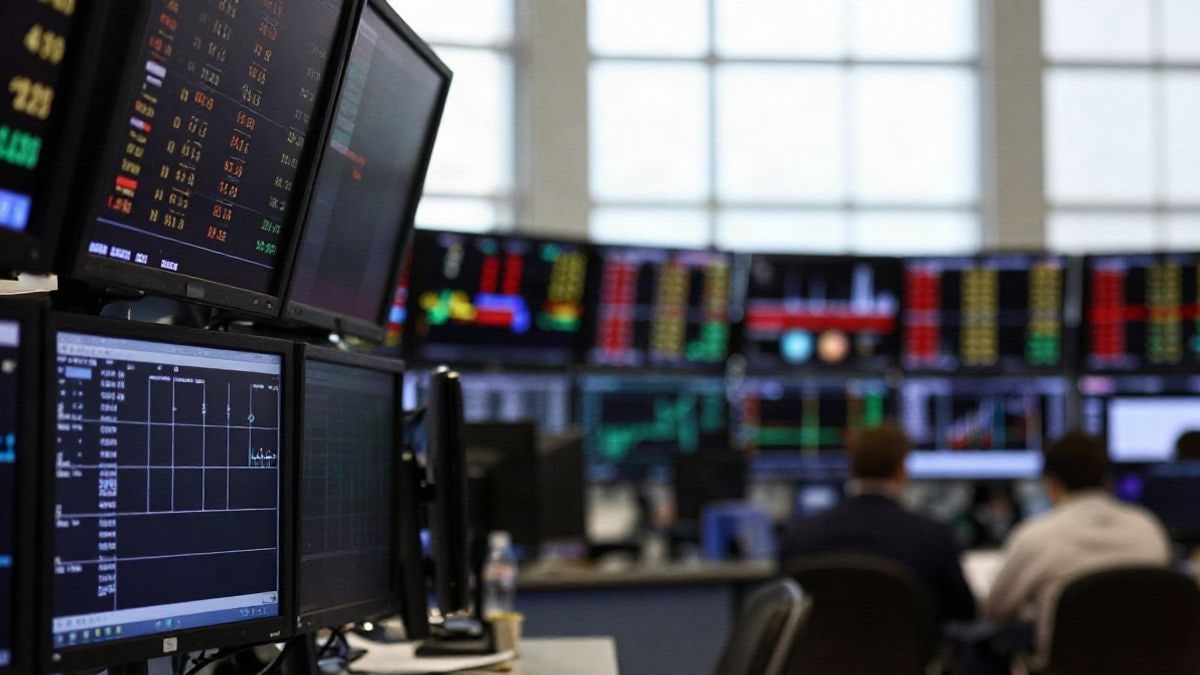
The Spanish index falls 0.7% in a session marked by rising bond yields and euro weakness, which hits 17-month lows against the dollar.
The IBEX 35 closed the session down 0.7%, at 19,211 points, in a day of high volatility where investors digested the announcement of general elections in Spain and the increasing pressure on European debt. The correction of the Spanish index contrasts with the performance of other European markets, where the DAX ended flat and the CAC fell by 0.8%, according to finanzas.com.
The market opened with doubts and even fell by 0.3%, down to 19,020 points, before recovering some lost ground. Volatility was fueled by the early election announcement made by Pedro Sánchez, which initially generated some noise, although it did not trigger massive sales related to political risk.
On the macroeconomic front, investors showed relief at the weak employment data from the United States for September, when only 29,000 jobs were created, compared to the expected 85,000. This figure, along with somewhat moderated inflation, has lowered expectations for further rate hikes by the Federal Reserve. In fact, the probability of an increase in October has plummeted from 64.2% to 18.3% in just a week, according to data collected by eToro.
However, pressure on bonds remains the main focus of concern. The yield on the ten-year US bond has reached 5.34%, its highest level since 2002. In Europe, the epicentre of tension is in France, where the risk premium over the German Bund has exceeded 150 basis points. Futures on French debt are trading lower this Monday, amid fears that fiscal problems and political deadlock in Paris will extend to the rest of European debt.
The single currency has been one of the main collateral victims. The euro has fallen by more than 0.8%, down to 1.1161 dollars, its lowest level in 17 months. Analysts warn that the speed at which yields are rising and the spread between France and Germany is widening deserves special attention.
In the commodities market, Brent has retreated by around 0.5%, down to 101.75 dollars per barrel, while West Texas has fallen nearly 1%, down to 90 dollars. The increase in crude oil exports from the Middle East and the G7's decision to release strategic reserves are expanding the available supply and partially offsetting the fears caused by the conflict in the region.
Within the IBEX 35, the biggest gains were for Banco Santander, which rose by 2.7%, boosted by Flavio Bolsonaro's victory in the first round of the Brazilian elections. Telefónica advanced by 2.7% and Repsol by 1.3%, the same percentage as Merlin Properties. On the negative side, the biggest drops were for Acciona and Fluidra, which fell by 1.5%, followed by IAG, which lost 1%, and Indra, with a drop of 0.8%.
This Monday's agenda includes the PMI for services and composite for France and Germany, along with the industrial prices for August in the eurozone. The session will also be marked by the evolution of bonds, the situation in France, oil, and expectations regarding the Fed and interest rates.

You may also like