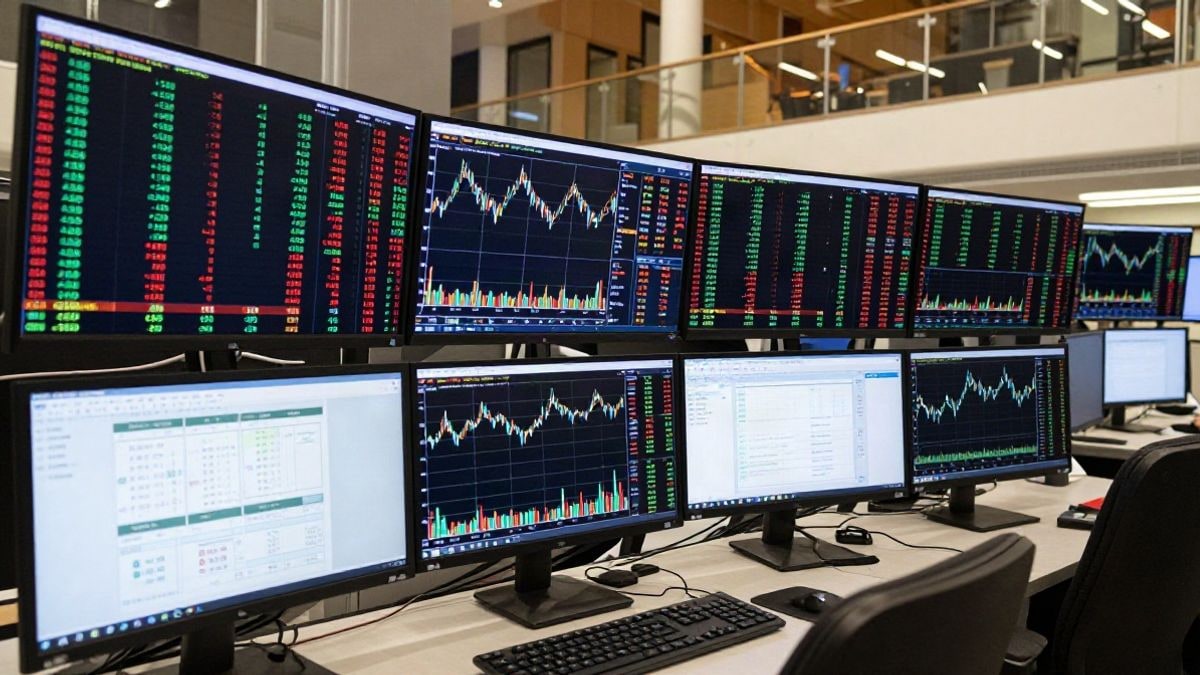
The IBEX 35 is the benchmark stock index of the Spanish market. It is a thermometer that measures how the 35 most liquid and capitalised companies listed on Spanish stock exchanges perform. When discussing the state of the economy and markets in Spain, the IBEX 35 is almost always the first indicator consulted, both among investors and in media and economic analyses.
Since its creation on January 14, 1992, the IBEX 35 has become the flagship of Bolsas y Mercados Españoles (BME) and serves as a reference for hundreds of financial products. It is not an arbitrary measure, but the result of a rigorous selection process that ensures only the most representative companies of the Spanish business fabric are included.
The index reflects the performance of the shares of these companies and provides a clear view of the evolution of the Spanish economy. Analysing its trajectory since 1992 allows us to understand what has happened to the Spanish stock market over the last few decades, including crises, recoveries, and moments of expansion.
Which 35 companies make it up
The IBEX 35 brings together the most important companies from strategic sectors such as banking, energy, telecommunications, infrastructure, consumption, and others. However, there is a common myth: not all the largest companies by sales volume are in the index. The selection responds to specific criteria of liquidity, capitalisation, and trading on the stock market.
The composition of the IBEX 35 is reviewed twice a year, usually in June and December, although extraordinary reviews can be called if significant events occur. The Technical Advisory Committee (CAT) is the independent body responsible for these decisions. It is made up of professionals outside the governance of BME and has a permanent and effective oversight function over the index's formulation.
In addition to the ordinary semi-annual reviews, there are quarterly follow-up reviews to assess significant changes in the liquidity of the securities. This ensures that the index always reflects the current reality of the most liquid Spanish market.
How the securities that make it up are selected
For a company to be part of the IBEX 35, it must meet very specific requirements. The first is that its shares must be admitted for trading on the Electronic Stock Interconnection System (SIBE), which is the technological platform where securities are traded on the four Spanish stock exchanges: Madrid, Barcelona, Bilbao, and Valencia.
Secondly, the shares must be of high liquidity, meaning they are among the most traded on the continuous market. This guarantees that there is sufficient buying and selling volume, allowing the index to be representative of real investor preferences.
Other requirements include that the company's average capitalisation must be above 0.30% of the total average capitalisation of the index, and that it has been traded in at least one-third of the sessions during the control period (six months between one review and another). If a security is among the 20 with the highest capitalisation, it can be selected even if it does not fully meet the trading requirement.
The Technical Advisory Committee examines factors such as the unit price of each share, the percentage variation compared to the previous session, the volume of trades in euros, the total capitalisation of the company, the PER (price-earnings ratio), and the dividend yield. Only after this thorough analysis are the 35 companies that will be part of the index defined.
How the value of the IBEX 35 is calculated
The IBEX 35 is a capitalisation-weighted index adjusted for free float. This means that not all companies have the same weight in the index calculation. Companies with higher capitalisation have a greater influence on its movements than smaller ones.
The capitalisation of a company is obtained by multiplying the number of shares outstanding by the current trading price. The value of the index on a specific day is calculated based on the value from the previous session and multiplying it by a percentage obtained by dividing the current sum of the capitalisations of the 35 companies by the sum of the capitalisations from the previous day.
To prevent extraordinary financial operations such as capital increases, reductions, or other corporate changes from artificially distorting the quotation, a corrective adjustment coefficient is applied. This way, the index reflects real changes in the market and not fluctuations caused by technical operations.
It is important to note that the IBEX 35 does not incorporate the payment of dividends or other forms of shareholder remuneration. It only reflects variations in the share prices, not the total return received by an investor holding those securities.
Why the IBEX 35 is important
The IBEX 35 is much more than a number that appears on Bloomberg screens or in economic news. It is a key indicator for assessing the economic and financial health of Spain. When the IBEX 35 rises, it generally means there is confidence in the country's economic outlook. When it falls, it often reflects concerns about the economy, although international factors can also influence it.
Its importance extends to serving as an underlying asset for countless derivative financial products, investment funds, life insurance linked to the stock market, and hedging strategies. Any investor looking to gain exposure to the Spanish market with a simple and diversified product has the IBEX 35 as a fundamental option.
For executives of Spanish companies, financial analysts, portfolio managers, and anyone interested in the country's economy, understanding what the IBEX 35 is and how it works is essential for interpreting daily economic information and making informed investment decisions.

You may also like