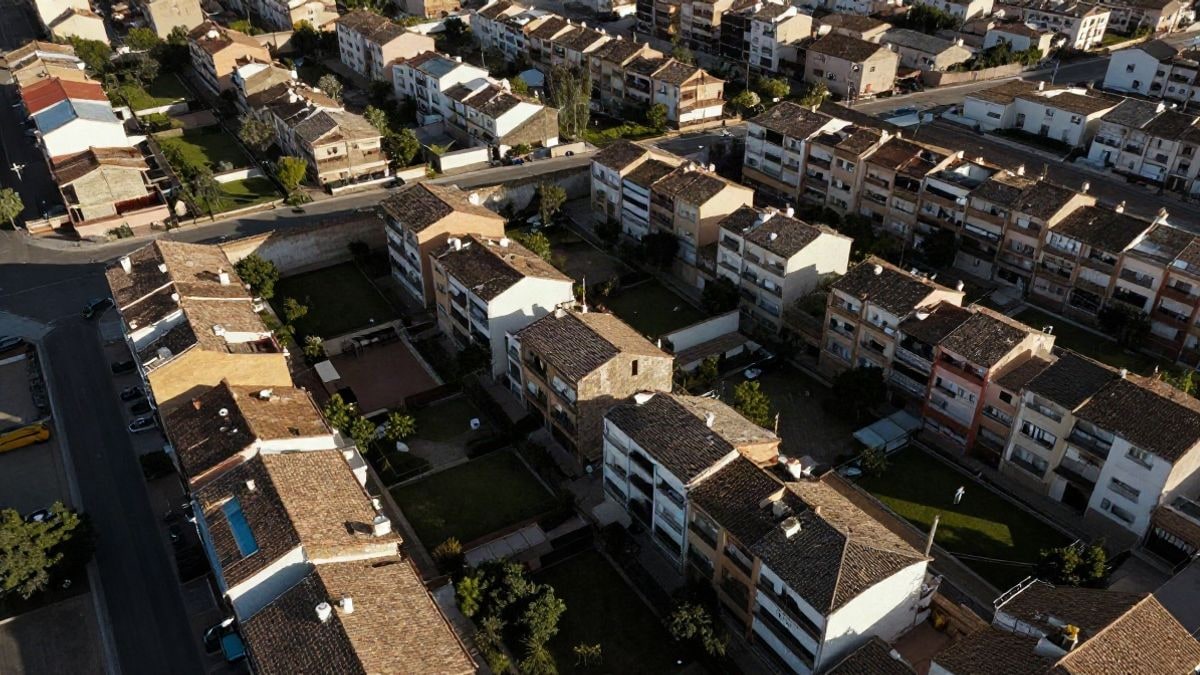
Public housing represents 1.5% of the residential stock in Spain, compared to an average of 7.1% in the OECD. The Government promotes Casa 47 and a state plan of €7 billion to increase affordable housing supply.
Public housing in Spain accounts for around 1.5% of the residential stock, a proportion five times lower than the 7.1% average among OECD countries. This is noted by the Bank of Spain in a report echoed by murciaeconomia.com, which places Spain among the European countries with the least public housing stock.
The comparison with major EU partners reveals the gap: the United Kingdom reaches 16.4% of public housing in relation to the total residential stock, while France hovers around 14%. Far below are Germany, with 2.6%, and Portugal, with 1.1%.
The Spanish Government has activated several instruments to increase the affordable housing supply. The main one is Casa 47, the new public housing and land entity that will incorporate part of the assets from Sareb and public land to develop new residential projects.
In addition, the State Housing Plan 2026-2030, endowed with €7 billion, aims to support autonomous communities and municipalities in expanding the affordable and social housing stock. This week, the Executive has approved new measures, including funds for social housing, the incorporation of public properties into Casa 47, and new financing mechanisms.
The French model is one of the most developed in Europe. Certain municipalities are required to ensure that at least 20% of their residential stock is social, a percentage that can rise to 25% in cities with higher housing pressure.
In the United Kingdom, the public stock far exceeds that of Spain, but demand remains high: around 1.34 million households are on the waiting list for social housing. The British Government plans to build 1.5 million homes in England during the legislative period and has launched a support programme of £39 billion until 2036.
Vienna is another frequently cited case. The city council of the Austrian capital owns around 220,000 homes, in addition to another 200,000 built with public subsidies and managed by cooperatives. The result is that around 60% of the population lives in rental housing. Finland has also developed models of protected rental and intermediate formulas between renting and ownership.
European experience shows that a larger social housing stock does not alone eliminate imbalances. The Netherlands faces an estimated deficit of 384,000 homes despite its extensive protected stock. Germany had just over a million social homes at the end of 2024, approximately half of what it had in 2006. In cities like Munich, Berlin, Milan, Florence, or Rome, rent continues to absorb a significant portion of household income.
The European Commission has for the first time placed housing among its major economic and social priorities. Brussels estimates an annual investment deficit of around €150 billion to meet the needs for affordable and sustainable housing in the EU, and is preparing a European platform to mobilise public and private financing. Planned actions include around €10 billion in additional investment through InvestEU during 2026 and 2027, as well as the possibility of redirecting cohesion funds towards housing.

You may also like