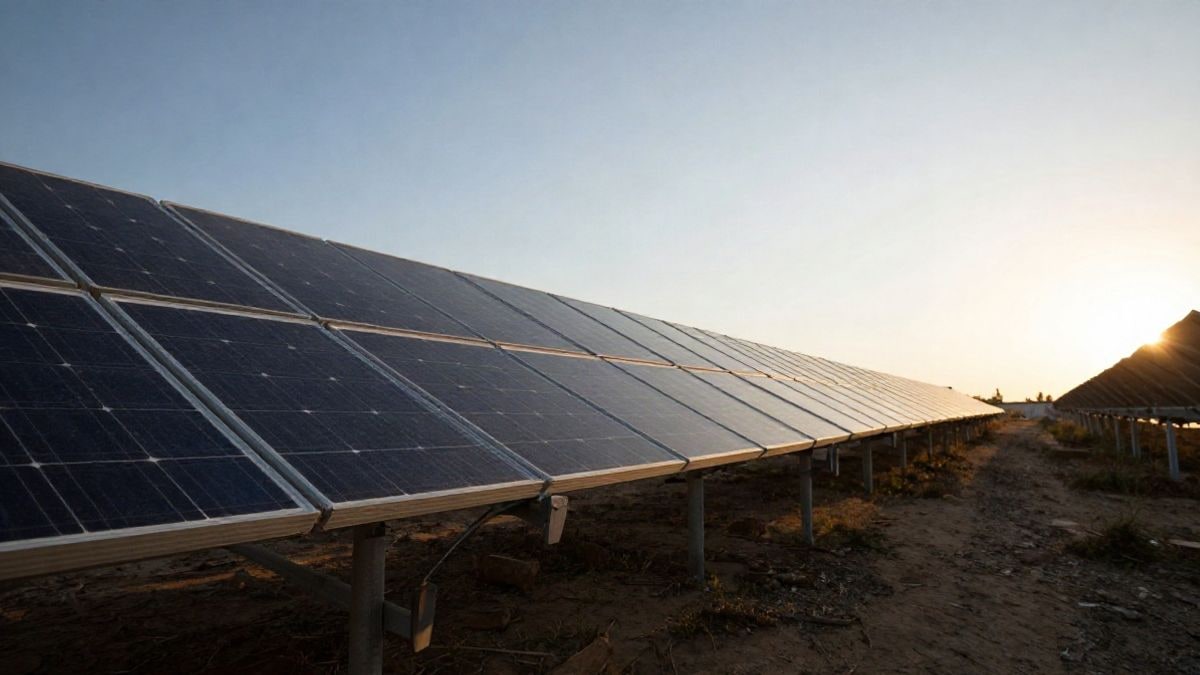
The Vice President of the ECB Supervisory Board, Frank Elderson, calls for replacing fossil fuels with clean electricity to gain autonomy and competitiveness. Currently, 23% of the EU economy is electrified and 90% continues to burn molecules.
The European Union needs to accelerate decarbonisation, incentivise clean generation, electrify its industry, and improve its electrical networks to gain competitiveness and reduce energy dependence. This is the conclusion of officials from community institutions and large companies gathered at a forum organised by the think tank Friends of Europe, as reported by elperiodicodelaenergia.com.
The Vice President of the European Central Bank (ECB), Frank Elderson, summarised the potential of renewables with a phrase: "The sun takes only eight minutes to reach Europe and does not pass through the Strait of Hormuz." Elderson highlighted that clean energies simultaneously reinforce European autonomy, security, and competitiveness.
Current data shows the room for improvement: around 38% of the electricity generated in the EU comes from renewable or nuclear sources, but only 23% of the European economy is electrified. "90% of the economy continues to burn molecules," said the ECB official, who advocated for accelerating the replacement of fossil fuels with clean electricity.
"The world is not well, but we must not despair," Elderson stated, for whom Europe is living, despite everything, "a fantastic moment" because it already has the necessary technologies and "we just need to invest."
The central bank member linked the energy transition with defence: "We can be energy independent, which is also related to defence." He added that reducing dependence on fossil fuels would decrease the volatility affecting price stability.
From Microsoft, its Vice President and Head of Sustainability, Melanie Nakagawa, pointed out at the same forum that, in the face of unpredictable financial markets, the energy transition offers a clearer horizon and represents an "incredible opportunity" to use clean energy in the expansion of digitalisation and artificial intelligence (AI).
Nakagawa highlighted that Europe has relatively stable and resilient networks that allow for the development of a clean energy strategy for data centres. Although she avoided guaranteeing that Microsoft would invest exclusively in clean energy in Europe, she assured that it is a "key priority" for the company.
The Head of Sustainability at Google for Europe, the Middle East, and Africa, Adam Elman, agreed that promoting AI and accelerating the energy transition "can go hand in hand," although he warned that "doing it right is something that cannot be done by one company alone." Elman called for a clear political roadmap and warned that some connections to European electrical networks take between seven and thirteen years. "This really does not help Europe get on the path to clean energy," he noted.
From the business sector, the Director of European Affairs at Engie, Corinna Grajetzky, argued that the development of data centres should progress "in parallel with the necessary energy assets to support them," in what she defined as a "twin transition," accompanied by more networks, flexibility, and new carbon-free generation.
The CEO of the Belgian multinational Umicore, Bart Sap, advocated for leveraging European "buying power" to attract Chinese technology and industrial capacity, especially in the refining of critical minerals. "We need to invite China to the EU and invest here," said Sap, who considered there is a "unique opportunity for Europe" to cooperate "from a position of balance," demanding that these technologies also be installed on European soil, as Western companies did in China thirty years ago.

You may also like


